
Democratic Senator Jeanne Shaheen's comments came amid a major downturn between New Delhi and Washington after US President Donald Trump doubled tariffs on Indian goods to a whopping 50 percent, including a 25 percent additional duties for India's purchase of Russian crude oil.

Taking Kharg would give the US control over virtually all of Iran's oil exports and thus provide significant leverage, notes Prem Panicker in his must read daily blog on the Gulf War. It would also put American troops within range of Iran's remaining missiles, drones, and artillery on a piece of real estate that is just eight square miles in size, and just 15 miles from the Iranian mainland.

Even as Russia and West Asia have been slugging it out for market share in India to sell their crude oil, the US is quietly making its moves on the sidelines. The US has doubled its share of the Indian crude market in the past few months, according to industry sources and ship-tracking data. Some of the increase in America's market share may have come at the expense of Russia, India's biggest crude oil supplier, said industry sources.
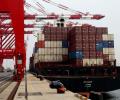
On the back of rising crude oil purchases, India's bill for imports from sanctions-hit Russia jumped 3.5 times in a year in April to $2.3 billion, showed data from the commerce ministry. In April, India's crude oil imports from Russia were valued at $1.3 billion, 57 per cent of India's total inbound shipments from Russia. Other major imported items during the month included coal, soybean and sunflower oil, fertilisers, and non-industrial diamonds. That month, Russia was also the fourth-largest crude petroleum supplier to India, after Iraq, Saudi Arabia, and the United Arab Emirates (UAE).

India's brittle energy security is inextricably linked to two opposing paradigms - fossil fuels, and the transition to green energy. The first powers the present; the second paves the way for Viksit Bharat in 2047.

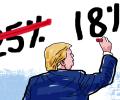
India will now face a lower reciprocal tariff of 10 per cent, down from 25 per cent, after US President Donald Trump announced a new global levy on items imported into America in the wake of the Supreme Court verdict against his sweeping duties on several nations.

India and the US have decided to reschedule their meeting to finalize the interim trade pact due to recent developments and implications, including changes in US tariffs.

If the oil infrastructure is attacked by the United States, the whole area could be flooded with oil, spilling into the Persian Gulf.

From the Sensex firms, HCL Tech, Infosys, Power Grid, Tata Consultancy Services, HDFC Bank, Hindustan Unilever, Bharti Airtel and ICICI Bank were among the major laggards. However, Titan, Larsen & Toubro, Maruti and Axis Bank were among the gainers.
'Trump says India will buy over $500 billion of US goods.' 'At present, India's annual imports of goods and energy from the US are under $50 billion.' 'Reaching $500 billion would likely require more than 20 years, suggesting the figure refers to a long-term aspiration rather than a near-term commitment.'
India's imports from Russia rose 64 per cent to $36.27 billion during the April-October period this fiscal on higher shipments of crude oil and fertiliser, according to the commerce ministry data. With this, Russia has become India's second-largest import source during the first seven months of this fiscal. The imports were $22.13 billion during April-October 2022.

Following a Supreme Court setback, Donald Trump has announced an increase in global tariffs from 10% to 15%, impacting international trade relations and raising concerns about economic repercussions.

The purge in Washington does not pause the war. Strikes continue, Hormuz remains closed, and Brent crude is still dancing around $109 a barrel. For India, the command chaos in the Pentagon is another layer of uncertainty piled on five weeks of conflict that was already straining every buffer Delhi has.

Investor sentiment across Asian markets has shifted sharply in August, reveals the latest Bank of America (BofA) Fund Manager Survey, which found global growth expectations retreating after three months of improvement.

'The biggest point of contention is market access for US agricultural and dairy products.'

The United States action of levying 25 per cent additional tariff on Indian goods is 'unfair, unjustified and unreasonable', India said on Wednesday in a firm reaction, signalling increasing tensions between the two strategic partners over New Delhi's energy ties with Moscow.

India has managed high government debt-to-GDP, a slowing domestic revenue engine, lower household savings and a more hostile geopolitical environment separately in the past. But together, they threaten to undo the growth narrative on which today's optimism rests, warns Debashis Basu.

India and the US are expected to sign the first phase of a bilateral trade agreement by mid-March, which will result in the US lowering import duties on Indian goods. India will then begin reducing import duties on certain US goods.
India and the US are expected to sign the first phase of a bilateral trade agreement by mid-March, which will result in the US lowering import duties on Indian goods. India will then begin reducing import duties on certain US goods.

'Don't look at Russia only as a place to earn quickly and then leave.' 'Try to build experience in serious companies, skills and certifications that will serve you anywhere in the world.'
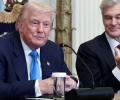
US President Donald Trump announced a deal with Pakistan to develop its oil reserves, suggesting Pakistan might sell oil to India in the future.

Israel and the United States had a plan. Iran punched back. And now the Gulf is reeling, the world is beginning to feel the pain and, as on date, no one in Washington or Tel Aviv appears willing to admit that the punch has landed, notes Prem Panicker, continuing his must-read blog on the war in the Middle East.

The delegations from the US and Iran head to Islamabad on Friday, carrying a ceasefire that is already fraying, a Strait that is technically open and practically closed, and a negotiating agenda that would challenge even parties actually negotiating in good faith, which these groups are not. Prem Panicker continues his must read blog on the Iran War.
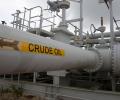
India's imports from Russia rose by about 67 per cent to $30.42 billion during the April-September period this fiscal on higher shipments of crude oil and fertiliser, according to the commerce ministry data. With this, Russia has become India's second-largest import source during the first half of this fiscal. The imports were $18.24 billion during April-September 2022.
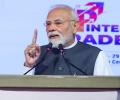
"This time, the country partner of the trade show is Russia. That means we are further strengthening a time-tested partnership through this trade show," the Prime Minister said.

Russian oil supplies to India will continue to flow unhindered and suppliers will come up with ways to sidestep secondary sanctions, a Russian official told Business Standard.

'I do believe there will be a resolution in the next couple of months on the penal tariff and hopefully on the reciprocal tariff also.'

Commerce and Industry Minister Piyush Goyal on Tuesday expressed hope that India will conclude the proposed bilateral trade agreement (BTA) with the US by the fall or November this year. He said that "a little bit" of geopolitical issues overtook the trade matters in the negotiations for the pact between the two countries.

'...it should not delude itself into thinking that India's security or its great-power ambitions will be advanced by those partnerships.'
'Instead, what India should focus on is on riding out the next three-and-a-half years of Trump's presidency with minimal damage to itself.'
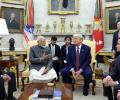
Trade, defence cooperation and regional strategy had long formed the backbone of India-US ties, but the latest rift shows how quickly those pillars can be shaken by personal grievances and political optics.
A few years ago, when top officials of Indian state-run refiners went to Dubai to negotiate a crude oil supply contract, a senior official from state-owned Saudi Aramco told them, "We can negotiate on anything, but I am the last man standing for you. "Nobody can offer the range of crudes we do with certainty," an official who was part of the negotiating team recalls. Perhaps that explains why Saudi Arabia is less concerned about losing its place as India's premier oil supplier to an upstart like Russia, which emerged from nowhere to become India's biggest crude oil supplier in September and October.

'The contours of the trade deal need to be reworked now.'

External Affairs Minister S Jaishankar on Monday met United States Secretary of State Marco Rubio for bilateral discussions, as the high-level 80th session of the United Nations General Assembly (UNGA) kicks in.

The pause gives the US time to breathe, to regroup, to move its expeditionary force into position without risk of interception along the way. It gives Iran nothing -- on the ground, attacks against its infrastructure continue apace. Prem Panicker in his must read daily blog on the Gulf War.
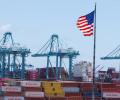
Indian exports to the US will face a 10% tariff, down from 25%, for 150 days following a US Supreme Court ruling. However, uncertainty persists due to potential further tariff hikes and long-term implications.

Global emerging market investors are sharply cutting back on India, making it the largest underweight market, as funds rotate into China, Hong Kong, and South Korea amid tariff shocks and valuation concerns.
India will need to travel back in time and seek inspiration from football greats Tulsidas Balaram and Chuni Goswami to deftly dribble around and sidestep the West-imposed price cap on exports of Russian seaborne crude oil. India depends on imported oil to meet 86 per cent of its needs, of which nearly a quarter now comes from Russia. The copious flows are roughly 10 per cent cheaper than competing suppliers helping India save billions of dollars in fuel costs.
Trump administration's chief negotiator Brendan Lynch is arriving in India to hold talks on the India-US bilateral trade deal, which were impacted after the US imposed 50 per cent import tariffs on Indian goods.

Commerce and Industry Minister Piyush Goyal announced that an interim trade agreement between India and the US is likely to be signed in March and operationalised in April, with chief negotiators meeting in Washington to finalize the details.
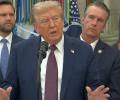
"I understood tariffs better than any human being in the world. And now with my tariffs, they were all dropping them. India was the most highly tariffed nation... And you know what, they've offered me no tariffs in India anymore. No tariffs," Trump said.
